The Two Babylons
Chapter V
Rites and Ceremonies
Section V
Lamps and Wax-Candles
Another peculiarity of the Papal worship is the use of lamps and wax-candles. If the Madonna and child are set up in a niche, they must have a lamp to burn before them; if mass is to be celebrated, though in broad daylight, there must be wax-candles lighted on the altar; if a grand procession is to be formed, it cannot be thorough and complete without lighted tapers to grace the goodly show. The use of these lamps and tapers comes from the same source as all the rest of the Papal superstition. That which caused the "Heart," when it became an emblem of the incarnate Son, to be represented as a heart on fire, required also that burning lamps and lighted candles should form part of the worship of that Son; for so, according to the established rites of Zoroaster, was the sun-god worshipped. When every Egyptian on the same night was required to light a lamp before his house in the open air, this was an act of homage to the sun, that had veiled its glory by enshrouding itself in a human form. When the Yezidis of Koordistan, at this day, once a year celebrate their festival of "burning lamps," that, too, is to the honour of Sheikh Shems, or the Sun. Now, what on these high occasions was done on a grand scale was also done on a smaller scale, in the individual acts of worship to their god, by the lighting of lamps and tapers before the favourite divinity. In Babylon, this practice had been exceedingly prevalent, as we learn from the Apocryphal writer of the Book of Baruch. "They (the Babylonians)," says he, "light up lamps to their gods, and that in greater numbers, too, than they do for themselves, although the gods cannot see one of them, and are senseless as the beams of their houses." In Pagan Rome, the same practice was observed. Thus we find Licinius, the Pagan Emperor, before joining battle with Constantine, his rival, calling a council of his friends in a thick wood, and there offering sacrifices to his gods, "lighting up wax-tapers" before them, and at the same time, in his speech, giving his gods a hint, that if they did not give him the victory against Constantine, his enemy and theirs, he would be under the necessity of abandoning their worship, and lighting up no more "wax-tapers to their honour." In the Pagan processions, also, at Rome, the wax-candles largely figured. "At these solemnities," says Dr. Middleton, referring to Apuleius as his authority, "at these solemnities, the chief magistrate used frequently to assist, in robes of ceremony, attended by the priests in surplices, with wax-candles in their hands, carrying upon a pageant or thensa, the images of their gods, dressed out in their best clothes; these were usually followed by the principal youth of the place, in white linen vestments or surplices, singing hymns in honour of the gods whose festivals they were celebrating, accompanied by crowds of all sorts that were initiated in the same religion, all with flambeaux or wax-candles in their hands." Now, so thoroughly and exclusively Pagan was this custom of lighting up lamps and candles in daylight, that we find Christian writers, such as Lactantius, in the fourth century, exposing the absurdity of the practice, and deriding the Romans "for lighting up candles to God, as if He lived in the dark." Had such a custom at that time gained the least footing among Christians, Lactantius could never have ridiculed it as he does, as a practice peculiar to Paganism. But what was unknown to the Christian Church in the beginning of the fourth century, soon thereafter began to creep in, and now forms one of the most marked peculiarities of that community that boasts that it is the "Mother and mistress of all Churches."
While Rome uses both lamps and wax-candles in her sacred rites, it is evident, however, that she attributes some pre-eminent virtue to the latter above all other lights. Up to the time of the Council of Trent, she thus prayed on Easter Eve, at the blessing of the Easter candles: "Calling upon thee in thy works, this holy Eve of Easter, we offer most humbly unto thy Majesty this sacrifice; namely, a fire not defiled with the fat of flesh, nor polluted with unholy oil or ointment, nor attained with any profane fire; but we offer unto thee with obedience, proceeding from perfect devotion, a fire of wrought WAX and wick, kindled and made to burn in honour of thy name. This so great a MYSTERY therefore, and the marvellous sacrament of this holy eve, must needs be extolled with due and deserved praises." That there was some occult "Mystery," as is here declared, couched under the "wax-candles," in the original system of idolatry, from which Rome derived its ritual, may be well believed, when it is observed with what unanimity nations the most remote have agreed to use wax-candles in their sacred rites. Among the Tungusians, near the Lake Baikal in Siberia, "wax-tapers are placed before the Burchans," the gods or idols of that country. In the Molucca Islands, wax-tapers are used in the worship of Nito, or Devil, whom these islanders adore. "Twenty or thirty persons having assembled," says Hurd, "they summon the Nito, by beating a small consecrated drum, whilst two or more of the company light up wax-tapers, and pronounce several mysterious words, which they consider as able to conjure him up." In the worship of Ceylon, the use of wax-candles is an indispensable requisite. "In Ceylon," says the same author, "some devotees, who are not priests, erect chapels for themselves, but in each of them they are obliged to have an image of Buddha, and light up tapers or wax-candles before it, and adorn it with flowers." A practice thus so general must have come from some primeval source, and must have originally had some mystic reason at the bottom of it. The wax-candle was, in fact, a hieroglyphic, like so many other things which we have already seen, and was intended to exhibit the Babylonian god in one of the essential characters of the Great Mediator. The classic reader may remember that one of the gods of primeval antiquity was called Ouranos, * that is, "The Enlightener."
* For Aor or our, "light," and an, "to act upon" or produce, the same as our English particle en, "to make." Ouranos, then, is "The Enlightener." This Ouranos is, by Sanchuniathon, the Phoenician, called the son of Elioun--i.e., as he himself, or Philo-Byblius, interprets the name, "The Most High." (SANCH) Ouranos, in the physical sense, is "The Shiner"; and by Hesychius it is made equivalent to Kronos, which also has the same meaning, for Krn, the verb from which it comes, signifies either "to put forth horns," or "to send forth rays of light"; and, therefore, while the epithet Kronos, or "The Horned One," had primarily reference to the physical power of Nimrod as a "mighty" king; when that king was deified, and made "Lord of Heaven," that name, Kronos, was still applied to him in his new character as "The Shiner or Lightgiver." The distinction made by Hesiod between Ouranos and Kronos, is no argument against the real substantial identity of these divinities originally as Pagan divinities; for Herodotus states that Hesiod had a hand in "inventing a theogony" for the Greeks, which implies that some at least of the details of that theogony must have come from his own fancy; and, on examination, it will be found, when the veil of allegory is removed, that Hesiod's "Ouranos," though introduced as one of the Pagan gods, was really at bottom the "God of Heaven," the living and true God.
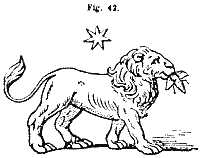
In this very character was Nimrod worshipped when he was deified. As the Sun-god he was regarded not only as the illuminator of the material world, but as the enlightener of the souls of men, for he was recognised as the revealer of "goodness and truth." It is evident, from the Old Testament, not less than the New, that the proper and personal name of our Lord Jesus Christ is, "The Word of God," as the Revealer of the heart and counsels of the Godhead. Now, to identify the Sun-god with the Great Revealer of the Godhead, while under the name of Mithra, he was exhibited in sculpture as a Lion; that Lion had a Bee represented between his lips. The bee between the lips of the sun-god was intended to point him out as "the Word"; for Dabar, the expression which signifies in Chaldee a "Bee," signifies also a "Word"; and the position of that bee in the mouth leaves no doubt as to the idea intended to be conveyed. It was intended to impress the belief that Mithra (who, says Plutarch, was worshipped as Mesites, "The Mediator"), in his character as Ouranos, "The Enlightener," was no other than that glorious one of whom the Evangelist John says, "In the beginning was the Word, and the Word was with God, and the Word was God. The same was in the beginning with God...In Him was life; and the life was THE LIGHT OF MEN." The Lord Jesus Christ ever was the revealer of the Godhead, and must have been known to the patriarchs as such; for the same Evangelist says, "No man hath seen God at any time: the only-begotten Son, which is in the bosom of the Father, He hath declared," that is, He hath revealed "Him." Before the Saviour came, the ancient Jews commonly spoke of the Messiah, or the Son of God, under the name of Dabar, or the "Word." This will appear from a consideration of what is stated in the 3rd chapter of 1st Samuel. In the first verse of that chapter it is said, "The WORD of the Lord was precious in those days; there was no open vision," that is, in consequence of the sin of Eli, the Lord had not, for a long time, revealed Himself in vision to him, as He did to the prophets. When the Lord had called Samuel, this "vision" of the God of Israel was restored (though not to Eli), for it is said in the last verse (v 21), "And the Lord APPEARED again in Shiloh; for the Lord revealed Himself to Samuel by the WORD of the Lord." Although the Lord spake to Samuel, this language implies more than speech, for it is said, "The LORD appeared"--i.e., was seen. When the Lord revealed Himself, or was seen by Samuel, it is said that it was "by (Dabar) the Word of the Lord." The "Word of the Lord" to be visible, must have been the personal "Word of God," that is, Christ. *
* After the Babylonish captivity, as the Chaldee Targums or Paraphrases of the Old Testament show, Christ was commonly called by the title "The Word of the Lord." In these Targums of later Chaldee, the term for "The Word" is "Mimra"; but this word, though a synonym for that which is used in the Hebrew Scriptures, is never used there. Dabar is the word employed. This is so well recognised that, in the Hebrew translation of John's Gospel in Bagster's Polyglott, the first verse runs thus: "In the beginning was the Word (Dabar)."
This had evidently been a primitive name by which He was known; and therefore it is not wonderful that Plato should speak of the second person of his Trinity under the name of the Logos, which is just a translation of "Dabar," or "the Word." Now, the light of the wax-candle, as the light from Dabar, "the Bee," was set up as the substitute of the light of Dabar, "the Word." Thus the apostates turned away from the "True Light," and set up a shadow in His stead. That this was really the case is plain; for, says Crabb, speaking of Saturn, "on his altars were placed wax-tapers lighted, because by Saturn men were reduced from the darkness of error to the light of truth." In Asiatic Greece, the Babylonian god was evidently recognised as the Light-giving "Word," for there we find the Bee occupying such a position as makes it very clear that it was a symbol of the great Revealer. Thus we find Muller referring to the symbols connected with the worship of the Ephesian Diana: "Her constant symbol is the bee, which is not otherwise attributed to Diana...The chief priest himself was called Essen, or the king-bee." The character of the chief priest shows the character of the god he represented. The contemplar divinity of Diana, the tower-bearing goddess, was of course the same divinity as invariably accompanied the Babylonian goddess: and this title of the priest shows that the Bee which appeared on her medals was just another symbol for her child, as the "Seed of the Woman," in his assumed character, as Dabar, "The Word" that enlightened the souls of men. That this is the precise "Mystery" couched under the wax-candles burning on the altars of the Papacy, we have very remarkable evidence from its own formularies; for, in the very same place in which the "Mystery" of the wax-candle is spoken of, thus does Rome refer to the Bee, by which the wax is produced: "Forasmuch as we do marvellously wonder, in considering the first beginning of this substance, to wit, wax-tapers, then must we of necessity greatly extol the original of Bees, for...they gather the flowers with their feet, yet the flowers are not injured thereby; they bring forth no young ones, but deliver their young swarms through their mouths, like as Christ (for a wonderful example) is proceeded from His Father's MOUTH." *
* Review of Epistle of DR. GENTIANUS HARVET of Louvaine. This work, which is commonly called The Beehive of the Roman Church, contains the original Latin of the passage translated above. The passage in question is to be found in at least two Roman Missals, which, however, are now very rare--viz., one printed at Vienna in 1506, with which the quotation in the text has been compared and verified; and one printed at Venice in 1522. These dates are antecedent to the establishment of the Reformation; and it appears that this passage was expunged from subsequent editions, as being unfit to stand the searching scrutiny to which everything in regard to religion was subjected in consequence of that great event. The ceremonial of blessing the candles, however, which has no place in the Pontificale Romanum in the Edinburgh Advocates' Library, is to be found in the Pontificale Romanum, Venice, 1542, and in Pontificale Romanum, Venice, 1572. In the ceremony of blessing the candles, given in the Roman Missal, printed at Paris, 1677, there is great praise of the Bee, strongly resembling the passage quoted in the text. The introduction of such an extraordinary formula into a religious ceremony is of very ancient date, and is distinctly traced to an Italian source; for, in the words of the Popish Bishop Ennodius, who occupied an Italian diocese in the sixth century, we find the counterpart of that under consideration. Thus, in a prayer in regard to the "Easter Candle," the reason for offering up the wax-candle is expressly declared to be, because that through means of the bees that produce the wax of which it is made, "earth has an image of what is PECULIAR TO HEAVEN," and that in regard to the very subject of GENERATION; the bees being able, "through the virtue of herbs, to pour forth their young through their MOUTHS with less waste of time than all other creatures do in the ordinary way." This prayer contains the precise idea of the prayer in the text; and there is only one way of accounting for the origin of such an idea. It must have come from a Chaldean Liturgy.
Here it is evident that Christ is referred to as the "Word of God"; and how could any imagination ever have conceived such a parallel as is contained in this passage, had it not been for the equivoque [wordplay, double meaning] between "Dabar," "the Bee," and "Dabar," "The Word." In a Popish work already quoted, the Pancarpium Marianum, I find the Lord Jesus expressly called by the name of the Bee. Referring to Mary, under the title of "The Paradise of Delight," the author thus speaks: "In this Paradise that celestial Bee, that is, the incarnate Wisdom, did feed. Here it found that dropping honeycomb, with which the whole bitterness of the corrupted world has been turned into sweetness." This blasphemously represents the Lord Jesus as having derived everything necessary to bless the world from His mother! Could this ever have come from the Bible? No. It must have come only from the source where the writer learned to call "the incarnate Wisdom" by the name of the Bee. Now, as the equivoque from which such a name applied to the Lord Jesus springs, is founded only on the Babylonian tongue, it shows whence his theology has come, and it proves also to demonstration that this whole prayer about the blessing of wax-candles must have been drawn from a Babylonian prayer-book. Surely, at every step, the reader must see more and more the exactitude of the Divine name given to the woman on the seven mountains, "Mystery, Babylon the Great"!