The Two Babylons
Chapter IV
Doctrine and Discipline
Section I
Baptismal Regeneration
When Linacer, a distinguished physician, but bigoted Romanist, in the reign of Henry VIII first fell in with the New Testament, after reading it for a while, he tossed it from him with impatience and a great oath, exclaiming, "Either this book is not true, or we are not Christians." He saw at once that the system of Rome and the system of the New Testament were directly opposed to one another; and no one who impartially compares the two systems can come to any other conclusion. In passing from the Bible to the Breviary, it is like passing from light to darkness. While the one breathes glory to God in the highest, peace on earth, and good will to men, the other inculcates all that is dishonouring to the Most High, and ruinous to the moral and spiritual welfare of mankind. How came it that such pernicious doctrines and practices were embraced by the Papacy? Was the Bible so obscure or ambiguous that men naturally fell into the mistake of supposing that it required them to believe and practise the very opposite of what it did? No; the doctrine and discipline of the Papacy were never derived from the Bible. The fact that wherever it has the power, it lays the reading of the Bible under its ban, and either consigns that choicest gift of heavenly love to the flames, or shuts it up under lock and key, proves this of itself. But it can be still more conclusively established. A glance at the main pillars of the Papal system will sufficiently prove that its doctrine and discipline, in all essential respects, have been derived from Babylon. Let the reader now scan the evidence.
Section
I
Baptismal Regeneration
It is well known that regeneration by baptism is a fundamental article of Rome, yea, that it stands at the very threshold of the Roman system. So important, according to Rome, is baptism for this purpose, that, on the one hand, it is pronounced of "absolute necessity for salvation," * insomuch that infants dying without it cannot be admitted to glory; and on the other, its virtues are so great, that it is declared in all cases infallibly to "regenerate us by a new spiritual birth, making us children of God":--it is pronounced to be "the first door by which we enter into the fold of Jesus Christ, the first means by which we receive the grace of reconciliation with God; therefore the merits of His death are by baptism applied to our souls in so superabundant a manner, as fully to satisfy Divine justice for all demands against us, whether for original or actual sin."
* Bishop HAY'S Sincere Christian. There are two exceptions to this statement; the case of an infidel converted in a heathen land, where it is impossible to get baptism, and the case of a martyr "baptised," as it is called, "in his own blood"; but in all other cases, whether of young or old, the necessity is "absolute."
Now, in both respects this doctrine is absolutely anti-Scriptural; in both it is purely Pagan. It is anti-Scriptural, for the Lord Jesus Christ has expressly declared that infants, without the slightest respect to baptism or any external ordinance whatever, are capable of admission into all the glory of the heavenly world: "Suffer the little children to come unto Me, and forbid them not; for of such is the kingdom of heaven." John the Baptist, while yet in his mother's womb was so filled with joy at the advent of the Saviour, that, as soon as Mary's salutation sounded in the ears of his own mother, the unborn babe "leaped in the womb for joy." Had that child died at the birth, what could have excluded it from "the inheritance of the saints in light" for which it was so certainly "made meet"? Yet the Roman Catholic Bishop Hay, in defiance of very principle of God's Word, does not hesitate to pen the following: "Question: What becomes of young children who die without baptism? Answer: If a young child were put to death for the sake of Christ, this would be to it the baptism of blood, and carry it to heaven; but except in this case, as such infants are incapable of having the desire of baptism, with the other necessary dispositions, if they are not actually baptised with water, THEY CANNOT GO TO HEAVEN." As this doctrine never came from the Bible, whence came it? It came from heathenism. The classic reader cannot fail to remember where, and in what melancholy plight, Aeneas, when he visited the infernal regions, found the souls of unhappy infants who had died before receiving, so to speak, "the rites of the Church":
"Before
the gates the cries of babes new-born,
Whom fate had from their tender mothers torn,
Assault his ears."
These wretched babes, to glorify the virtue and efficacy of the mystic rites of Paganism, are excluded from the Elysian Fields, the paradise of the heathen, and have among their nearest associates no better company than that of guilty suicides:
"The
next in place and punishment are they
Who prodigally threw their souls away,
Fools, who, repining at their wretched state,
And loathing anxious life, suborned their fate." *
* Virgil, DRYDEN'S translation. Between the infants and the suicides one other class is interposed, that is, those who on earth have been unjustly condemned to die. Hope is held out for these, but no hope is held out for the babes.
So much for the lack of baptism. Then as to its positive efficacy when obtained, the Papal doctrine is equally anti-Scriptural. There are professed Protestants who hold the doctrine of Baptismal Regeneration; but the Word of God knows nothing of it. The Scriptural account of baptism is, not that it communicates the new birth, but that it is the appointed means of signifying and sealing that new birth where it already exists. In this respect baptism stands on the very same ground as circumcision. Now, what says God's Word of the efficacy of circumcision? This it says, speaking of Abraham: "He received the sign of circumcision, a seal of the righteousness of the faith which he had, yet being uncircumcised" (Rom 4:11). Circumcision was not intended to make Abraham righteous; he was righteous already before he was circumcised. But it was intended to declare him righteous, to give him the more abundant evidence in his own consciousness of his being so. Had Abraham not been righteous before his circumcision, his circumcision could not have been a seal, could not have given confirmation to that which did not exist. So with baptism, it is "a seal of the righteousness of the faith" which the man "has before he is baptised"; for it is said, "He that believeth, and is baptised, shall be saved" (Mark 16:16). Where faith exists, if it be genuine, it is the evidence of a new heart, of a regenerated nature; and it is only on the profession of that faith and regeneration in the case of an adult, that he is admitted to baptism. Even in the case of infants, who can make no profession of faith or holiness, the administration of baptism is not for the purpose of regenerating them, or making them holy, but of declaring them "holy," in the sense of being fit for being consecrated, even in infancy, to the service of Christ, just as the whole nation of Israel, in consequence of their relation to Abraham, according to the flesh, were "holy unto the Lord." If they were not, in that figurative sense, "holy," they would not be fit subjects for baptism, which is the "seal" of a holy state. But the Bible pronounces them, in consequence of their descent from believing parents, to be "holy," and that even where only one of the parents is a believer: "The unbelieving husband is sanctified by the wife, and the unbelieving wife is sanctified by the husband; else were your children unclean, but now they are HOLY" (1 Cor 7:14). It is in consequence of, and solemnly to declare, that "holiness," with all the responsibilities attaching to it, that they are baptised. That "holiness," however, is very different from the "holiness" of the new nature; and although the very fact of baptism, if Scripturally viewed and duly improved, is, in the hand of the good Spirit of God, an important means of making that "holiness" a glorious reality, in the highest sense of the term, yet it does not in all cases necessarily secure their spiritual regeneration. God may, or may not, as He sees fit, give the new heart, before, or at, or after baptism; but manifest it is, that thousands who have been duly baptised are still unregenerate, are still in precisely the same position as Simon Magus, who, after being canonically baptised by Philip, was declared to be "in the gall of bitterness and the bond of iniquity" (Acts 7:23). The doctrine of Rome, however, is, that all who are canonically baptised, however ignorant, however immoral, if they only give implicit faith to the Church, and surrender their consciences to the priests, are as much regenerated as ever they can be, and that children coming from the waters of baptism are entirely purged from the stain of original sin. Hence we find the Jesuit missionaries in India boasting of making converts by thousands, by the mere fact of baptising them, without the least previous instruction, in the most complete ignorance of the truths of Christianity, on their mere profession of submission to Rome. This doctrine of Baptismal Regeneration also is essentially Babylonian. Some may perhaps stumble at the idea of regeneration at all having been known in the Pagan world; but if they only go to India, they will find at this day, the bigoted Hindoos, who have never opened their ears to Christian instruction, as familiar with the term and the idea as ourselves. The Brahmins make it their distinguishing boast that they are "twice-born" men, and that, as such, they are sure of eternal happiness. Now, the same was the case in Babylon, and there the new birth was conferred by baptism. In the Chaldean mysteries, before any instruction could be received, it was required first of all, that the person to be initiated submit to baptism in token of blind and implicit obedience. We find different ancient authors bearing direct testimony both to the fact of this baptism and the intention of it. "In certain sacred rites of the heathen," says Tertullian, especially referring to the worship of Isis and Mithra, "the mode of initiation is by baptism." The term "initiation" clearly shows that it was to the Mysteries of these divinities he referred. This baptism was by immersion, and seems to have been rather a rough and formidable process; for we find that he who passed through the purifying waters, and other necessary penances, "if he survived, was then admitted to the knowledge of the Mysteries." (Elliae Comment. in S. GREG. NAZ.) To face this ordeal required no little courage on the part of those who were initiated. There was this grand inducement, however, to submit, that they who were thus baptised were, as Tertullian assures us, promised, as the consequence, "REGENERATION, and the pardon of all their perjuries." Our own Pagan ancestors, the worshippers of Odin, are known to have practised baptismal rites, which, taken in connection with their avowed object in practising them, show that, originally, at least, they must have believed that the natural guilt and corruption of their new-born children could be washed away by sprinkling them with water, or by plunging them, as soon as born, into lakes or rivers. Yea, on the other side of the Atlantic, in Mexico, the same doctrine of baptismal regeneration was found in full vigour among the natives, when Cortez and his warriors landed on their shores. The ceremony of Mexican baptism, which was beheld with astonishment by the Spanish Roman Catholic missionaries, is thus strikingly described in Prescott's Conquest of Mexico: "When everything necessary for the baptism had been made ready, all the relations of the child were assembled, and the midwife, who was the person that performed the rite of baptism, * was summoned. At early dawn, they met together in the courtyard of the house. When the sun had risen, the midwife, taking the child in her arms, called for a little earthen vessel of water, while those about her placed the ornaments, which had been prepared for baptism, in the midst of the court. To perform the rite of baptism, she placed herself with her face toward the west, and immediately began to go through certain ceremonies...After this she sprinkled water on the head of the infant, saying, 'O my child, take and receive the water of the Lord of the world, which is our life, which is given for the increasing and renewing of our body. It is to wash and to purify. I pray that these heavenly drops may enter into your body, and dwell there; that they may destroy and remove from you all the evil and sin which was given you before the beginning of the world, since all of us are under its power'...She then washed the body of the child with water, and spoke in this manner: 'Whencesoever thou comest, thou that art hurtful to this child, leave him and depart from him, for he now liveth anew, and is BORN ANEW; now he is purified and cleansed afresh, and our mother Chalchivitylcue [the goddess of water] bringeth him into the world.' Having thus prayed, the midwife took the child in both hands, and, lifting him towards heaven, said, 'O Lord, thou seest here thy creature, whom thou hast sent into the world, this place of sorrow, suffering, and penitence. Grant him, O Lord, thy gifts and inspiration, for thou art the Great God, and with thee is the great goddess.'"
* As baptism is absolutely necessary to salvation, Rome also authorises midwives to administer baptism. In Mexico the midwife seems to have been a "priestess."
Here is the opus operatum without mistake. Here is baptismal regeneration and exorcism too, * as thorough and complete as any Romish priest or lover of Tractarianism could desire.
* In the Romish ceremony of baptism, the first thing the priest does is to exorcise the devil out of the child to be baptised in these words, "Depart from him, thou unclean spirit, and give place to the Holy Ghost the Comforter." (Sincere Christian) In the New Testament there is not the slightest hint of any such exorcism accompanying Christian Baptism. It is purely Pagan.
Does the reader ask what evidence is there that Mexico had derived this doctrine from Chaldea? The evidence is decisive. From the researches of Humboldt we find that the Mexicans celebrated Wodan as the founder of their race, just as our own ancestors did. The Wodan or Odin of Scandinavia can be proved to be the Adon of Babylon. (see note below) The Wodan of Mexico, from the following quotation, will be seen to be the very same: "According to the ancient traditions collected by the Bishop Francis Nunez de la Vega," says Humboldt, "the Wodan of the Chiapanese [of Mexico] was grandson of that illustrious old man, who at the time of the great deluge, in which the greater part of the human race perished, was saved on a raft, together with his family. Wodan co-operated in the construction of the great edifice which had been undertaken by men to reach the skies; the execution of this rash project was interrupted; each family received from that time a different language; and the great spirit Teotl ordered Wodan to go and people the country of Anahuac." This surely proves to demonstration whence originally came the Mexican mythology and whence also that doctrine of baptismal regeneration which the Mexicans held in common with Egyptian and Persian worshippers of the Chaldean Queen of Heaven. Prestcott, indeed, has cast doubts on the genuiness of this tradition, as being too exactly coincident with the Scriptural history to be easily believed. But the distinguished Humboldt, who had carefully examined the matter, and who had no prejudice to warp him, expresses his full belief in its correctness; and even from Prestcott's own interesting pages, it may be proved in every essential particular, with the single exception of the name of Wodan, to which he makes no reference. But, happily, the fact that that name had been borne by some illustrious hero among the supposed ancestors of the Mexican race, is put beyond all doubt by the singular circumstance that the Mexicans had one of their days called Wodansday, exactly as we ourselves have. This, taken in connection with all the circumstances, is a very striking proof, at once of the unity of the human race, and of the wide-spread diffusion of the system that began at Babel.
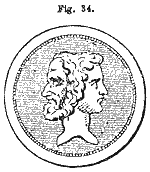
If the question arise, How came it that the Bayblonians themselves adopted such a doctrine as regeneration by baptism, we have light also on that. In the Babylonian Mysteries, the commemoration of the flood, of the ark, and the grand events in the life of Noah, was mingled with the worship of the Queen of Heaven and her son. Noah, as having lived in two worlds, both before the flood and after it, was called "Dipheus," or "twice-born," and was represented as a god with two heads looking in opposite directions, the one old, and the other young. Though we have seen that the two-headed Janus in one aspect had reference to Cush and his son, Nimrod, viewed as one god, in a two-fold capacity, as the Supreme, and Father of all the deified "mighty ones," yet, in order to gain for him the very authority and respect essential to constitute him properly the head of the great system of idolatry that the apostates inaugurated, it was necessary to represent him as in some way or other identified with the great patriarch, who was the Father of all, and who had so miraculous a history. Therefore in the legends of Janus, we find mixed up with other things derived from an entirely different source, statements not only in regard to his being the "Father of the world," but also his being "the inventor of ships," which plainly have been borrowed from the history of Noah; and therefore, the remarkable way in which he is represented in the figure here presented to the reader may confidently be concluded to have been primarily suggested by the history of the great Diluvian patriarch, whose integrity in his two-fold life is so particularly referred to in the Scripture, where it is said (Gen 6:9), "Noah was just a man, and perfect in his generations," that is, in his life before the flood, and in his life after it. The whole mythology of Greece and Rome, as well as Asia, is full of the history and deeds of Noah, which it is impossible to misunderstand. In India, the god Vishnu, "the Preserver," who is celebrated as having miraculously preserved one righteous family at the time when the world was drowned, not only has the story of Noah wrought up with his legend, but is called by his very name. Vishnu is just the Sanscrit form of the Chaldee "Ish-nuh," "the man Noah," or the "Man of rest." In the case of Indra, the "king of the gods," and god of rain, which is evidently only another form of the same god, the name is found in the precise form of Ishnu. Now, the very legend of Vishnu, that pretends to make him no mere creature, but the supreme and "eternal god," shows that this interpretation of the name is no mere unfounded imagination. Thus is he celebrated in the "Matsya Puran": "The sun, the wind, the ether, all things incorporeal, were absorbed into his Divine essence; and the universe being consumed, the eternal and omnipotent god, having assumed an ancient form, REPOSED mysteriously upon the surface of that (universal) ocean. But no one is capable of knowing whether that being was then visible or invisible, or what the holy name of that person was, or what the cause of his mysterious SLUMBER. Nor can any one tell how long he thus REPOSED until he conceived the thought of acting; for no one saw him, no one approached him, and none can penetrate the mystery of his real essence." (Col. KENNEDY'S Hindoo Mythology) In conformity with this ancient legend, Vishnu is still represented as sleeping four months every year. Now, connect this story with the name of Noah, the man of "Rest," and with his personal history during the period of the flood, when the world was destroyed, when for forty days and forty nights all was chaos, when neither sun nor moon nor twinkling star appeared, when sea and sky were mingled, and all was one wide universal "ocean," on the bosom of which the patriarch floated, when there was no human being to "approach" him but those who were with him in the ark, and "the mystery of his real essence is penetrated" at once, "the holy name of that person" is ascertained, and his "mysterious slumber" fully accounted for. Now, wherever Noah is celebrated, whether by the name of Saturn, "the hidden one,"--for that name was applied to him as well as to Nimrod, on account of his having been "hidden" in the ark, in the "day of the Lord's fierce anger,"--or, "Oannes," or "Janus," the "Man of the Sea," he is generally described in such a way as shows that he was looked upon as Diphues, "twice-born," or "regenerate." The "twice-born" Brahmins, who are all so many gods upon earth, by the very title they take to themselves, show that the god whom they represent, and to whose prerogatives they lay claim, had been known as the "twice-born" god. The connection of "regeneration" with the history of Noah, comes out with special evidence in the accounts handed down to us of the Mysteries as celebrated in Egypt. The most learned explorers of Egyptian antiquities, including Sir Gardiner Wilkinson, admit that the story of Noah was mixed up with the story of Osiris. The ship of Isis, and the coffin of Osiris, floating on the waters, point distinctly to that remarkable event. There were different periods, in different places in Egypt, when the fate of Osiris was lamented; and at one time there was more special reference to the personal history of "the mighty hunter before the Lord," and at another to the awful catastrophe through which Noah passed. In the great and solemn festival called "The Disappearance of Osiris," it is evident that it is Noah himself who was then supposed to have been lost. The time when Osiris was "shut up in his coffin," and when that coffin was set afloat on the waters, as stated by Plutarch, agrees exactly with the period when Noah entered the ark. That time was "the 17th day of the month Athyr, when the overflowing of the Nile had ceased, when the nights were growing long and the days decreasing." The month Athyr was the second month after the autumnal equinox, at which time the civil year of the Jews and the patriarchs began. According to this statement, then, Osiris was "shut up in his coffin" on the 17th day of the second month of the patriarchal year. Compare this with the Scriptural account of Noah's entering into the ark, and it will be seen how remarkably they agree (Gen 7:11), "In the six hundredth year of Noah's life, in the SECOND MONTH, in the SEVENTEENTH DAY of the month, were all the fountains of the great deep broken up; in the self-same day entered Noah into the ark." The period, too, that Osiris (otherwise Adonis) was believed to have been shut up in his coffin, was precisely the same as Noah was confined in the ark, a whole year. *
* APOLLODORUS. THEOCRITUS, Idyll. Theocritus is speaking of Adonis as delivered by Venus from Acheron, or the infernal regions, after being there for a year; but as the scene is laid in Egypt, it is evident that it is Osiris he refers to, as he was the Adonis of the Egyptians.
Now, the statements of Plutarch demonstrate that, as Osiris at this festival was looked upon as dead and buried when put into his ark or coffin, and committed to the deep, so, when at length he came out of it again, that new state was regarded as a state of "new life," or "REGENERATION." *
* PLUTARCH, De Iside et Osiride. It was in the character of Pthah-Sokari-Osiris that he was represented as having been thus "buried" in the waters. In his own character, simply as Osiris, he had another burial altogether.
There seems every reason to believe that by the ark and the flood God actually gave to the patriarchal saints, and especially to righteous Noah, a vivid typical representation of the power of the blood and Spirit of Christ, at once in saving from wrath, and cleansing from all sin--a representation which was a most cheering "seal" and confirmation to the faith of those who really believed. To this Peter seems distinctly to allude, when he says, speaking of this very event, "The like figure whereunto baptism doth also now save us." Whatever primitive truth the Chaldean priests held, they utterly perverted and corrupted it. They willingly overlooked the fact, that it was "the righteousness of the faith" which Noah "had before" the flood, that carried him safely through the avenging waters of that dread catastrophe, and ushered him, as it were, from the womb of the ark, by a new birth, into a new world, when on the ark resting on Mount Ararat, he was released from his long confinement. They led their votaries to believe that, if they only passed through the baptismal waters, and the penances therewith connected, that of itself would make them like the second father of mankind, "Diphueis," "twice-born," or "regenerate," would entitle them to all the privileges of "righteous" Noah, and give them that "new birth" (palingenesia) which their consciences told them they so much needed. The Papacy acts on precisely the same principle; and from this very source has its doctrine of baptismal regeneration been derived, about which so much has been written and so many controversies been waged. Let men contend as they may, this, and this only, will be found to be the real origin of the anti-Scriptural dogma. *
* There have been considerable speculations about the meaning of the name Shinar, as applied to the region of which Babylon was the capital. Do not the facts above stated cast light on it? What so likely a derivation of this name as to derive it from "shene," "to repeat," and "naar," "childhood." The land of "Shinar," then, according to this view, is just the land of the "Regenerator."
The reader has seen already how faithfully Rome has copied the Pagan exorcism in connection with baptism. All the other peculiarities attending the Romish baptism, such as the use of salt, spittle, chrism, or anointing with oil, and marking the forehead with the sign of the cross, are equally Pagan. Some of the continental advocates of Rome have admitted that some of these at least have not been derived from Scripture. Thus Jodocus Tiletanus of Louvaine, defending the doctrine of "Unwritten Tradition," does not hesitate to say, "We are not satisfied with that which the apostles or the Gospel do declare, but we say that, as well before as after, there are divers matters of importance and weight accepted and received out of a doctrine which is nowhere set forth in writing. For we do blesse the water wherewith we baptize, and the oyle wherewith we annoynt; yea, and besides that, him that is christened. And (I pray you) out of what Scripture have we learned the same? Have we it not of a secret and unwritten ordinance? And further, what Scripture hath taught us to grease with oyle? Yea, I pray you, whence cometh it, that we do dype the childe three times in the water? Doth it not come out of this hidden and undisclosed doctrine, which our forefathers have received closely without any curiosity, and do observe it still." This learned divine of Louvaine, of course, maintains that "the hidden and undisclosed doctrine" of which he speaks, was the "unwritten word" handed down through the channel of infallibility, from the Apostles of Christ to his own time. But, after what we have already seen, the reader will probably entertain a different opinion of the source from which the hidden and undisclosed doctrine must have come. And, indeed, Father Newman himself admits, in regard to "holy water" (that is, water impregnated with "salt," and consecrated), and many other things that were, as he says, "the very instruments and appendages of demon-worship"--that they were all of "Pagan" origin, and "sanctified by adoption into the Church." What plea, then, what palliation can he offer, for so extraordinary an adoption? Why, this: that the Church had "confidence in the power of Christianity to resist the infection of evil," and to transmute them to "an evangelical use." What right had the Church to entertain any such "confidence"? What fellowship could light have with darkness? what concord between Christ and Belial? Let the history of the Church bear testimony to the vanity, yea, impiety of such a hope. Let the progress of our inquiries shed light upon the same. At the present stage, there is only one of the concomitant rites of baptism to which I will refer--viz., the use of "spittle" in that ordinance; and an examination of the very words of the Roman ritual, in applying it, will prove that its use in baptism must have come from the Mysteries. The following is the account of its application, as given by Bishop Hay: "The priest recites another exorcism, and at the end of it touches the ear and nostrils of the person to be baptised with a little spittle, saying, 'Ephpheta, that is, Be thou opened into an odour of sweetness; but be thou put to flight, O Devil, for the judgment of God will be at hand.'" Now, surely the reader will at once ask, what possible, what conceivable connection can there be between spittle, and an "odour of sweetness"? If the secret doctrine of the Chaldean mysteries be set side by side with this statement, it will be seen that, absurd and nonsensical as this collocation of terms may appear, it was not at random that "spittle" and an "odour of sweetness" were brought together. We have seen already how thoroughly Paganism was acquainted with the attributes and work of the promised Messiah, though all that acquaintance with these grand themes was used for the purpose of corrupting the minds of mankind, and keeping them in spiritual bondage. We have now to see that, as they were well aware of the existence of the Holy Spirit, so, intellectually, they were just as well acquainted with His work, though their knowledge on that subject was equally debased and degraded. Servius, in his comments upon Virgil's First Georgic, after quoting the well known expression, "Mystica vannus Iacchi," "the mystic fan of Bacchus," says that that "mystic fan" symbolised the "purifying of souls." Now, how could the fan be a symbol of the purification of souls? The answer is, The fan is an instrument for producing "wind"; * and in Chaldee, as has been already observed, it is one and the same word which signifies "wind" and the "Holy Spirit."
* There is an evident allusion to the "mystic fan" of the Babylonian god, in the doom of Babylon, as pronounced by Jeremiah 51:1, 2: "Thus saith the Lord, Behold, I will raise up against Babylon, and against them that dwell in the midst of them that rise up against me, a destroying wind; and will send unto Babylon fanners, that shall fan her, and shall empty her land."
There can be no doubt, that, from the very beginning, the "wind" was one of the Divine patriarchal emblems by which the power of the Holy Ghost was shadowed forth, even as our Lord Jesus Christ said to Nicodemus, "The wind bloweth where it listeth, and thou hearest the sound thereof, but canst not tell whence it cometh or whither it goeth: so is every one that is born of the Spirit." Hence, when Bacchus was represented with "the mystic fan," that was to declare him to be the mighty One with whom was "the residue of the Spirit." Hence came the idea of purifying the soul by means of the wind, according to the description of Virgil, who represents the stain and pollution of sin as being removed in this very way:
"For
this are various penances enjoined,
And some are hung to bleach upon the WIND."
Hence the priests of Jupiter (who was originally just another form of Bacchus), were called Flamens, * -- that is Breathers, or bestowers of the Holy Ghost, by breathing upon their votaries.
* From "Flo," "I breathe."
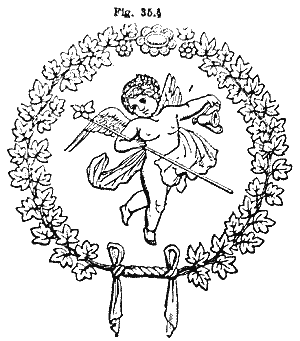
Now, in the Mysteries, the "spittle" was just another symbol for the same thing. In Egypt, through which the Babylonian system passed to Western Europe, the name of the "Pure or Purifying Spirit" was "Rekh" (BUNSEN). But "Rekh" also signified "spittle" (PARKHURST'S Lexicon); so that to anoint the nose and ears of the initiated with "spittle," according to the mystic system, was held to be anointing them with the "Purifying Spirit." That Rome in adopting the "spittle" actually copied from some Chaldean ritual in which "spittle" was the appointed emblem of the "Spirit," is plain from the account which she gives in her own recognised formularies of the reason for anointing the ears with it. The reason for anointing the ears with "spittle" says Bishop Hay, is because "by the grace of baptism, the ears of our soul are opened to hear the Word of God, and the inspirations of His Holy Spirit." But what, it may be asked, has the "spittle" to do with the "odour of sweetness"? I answer, The very word "Rekh," which signified the "Holy Spirit," and was visibly represented by the "spittle," was intimately connected with "Rikh," which signifies a "fragrant smell," or "odour of sweetness." Thus, a knowledge of the Mysteries gives sense and a consistent meaning to the cabalistic saying addressed by the Papal baptiser to the person about to be baptised, when the "spittle" is daubed on his nose and ears, which otherwise would have no meaning at all--"Ephpheta, Be thou opened into an odour of sweetness." While this was the primitive truth concealed under the "spittle," yet the whole spirit of Paganism was so opposed to the spirituality of the patriarchal religion, and indeed intended to make it void, and to draw men utterly away from it, while pretending to do homage to it, that among the multitude in general the magic use of "spittle" became the symbol of the grossest superstition. Theocritus shows with what debasing rites it was mixed up in Sicily and Greece; and Persius thus holds up to scorn the people of Rome in his day for their reliance on it to avert the influence of the "evil eye":
"Our
superstitions with our life begin;
The obscene old grandam, or the next of kin,
The new-born infant from the cradle takes,
And first of spittle a lustration makes;
Then in the spawl her middle finger dips,
Anoints the temples, forehead, and the lips,
Pretending force of magic to prevent
By virtue of her nasty excrement."--DRYDEN
While thus far we have seen how the Papal baptism is just a reproduction of the Chaldean, there is still one other point to be noticed, which makes the demonstration complete. That point is contained in the following tremendous curse fulminated against a man who committed the unpardonable offence of leaving the Church of Rome, and published grave and weighty reasons for so doing: "May the Father, who creates man, curse him! May the Son, who suffered for us, curse him! May the Holy Ghost who suffered for us in baptism, curse him!" I do not stop to show how absolutely and utterly opposed such a curse as this is to the whole spirit of the Gospel. But what I call the reader's attention to is the astounding statement that "the Holy Ghost suffered for us in baptism." Where in the whole compass of Scripture could warrant be found for such an assertion as this, or anything that could even suggest it? But let the reader revert to the Babylonian account of the personality of the Holy Ghost, and the amount of blasphemy contained in this language will be apparent. According to the Chaldean doctrine, Semiramis, the wife of Ninus or Nimrod, when exalted to divinity under the name of the Queen of Heaven, came, as we have seen, to be worshipped as Juno, the "Dove"--in other words, the Holy Spirit incarnate. Now, when her husband, for his blasphemous rebellion against the majesty of heaven, was cut off, for a season it was a time of tribulation also for her. The fragments of ancient history that have come down to us give an account of her trepidation and flight, to save herself from her adversaries. In the fables of the mythology, this flight was mystically represented in accordance with what was attributed to her husband. The bards of Greece represented Bacchus, when overcome by his enemies, as taking refuge in the depths of the ocean. Thus, Homer:
"In a
mad mood, while Bacchus blindly raged,
Lycurgus drove his trembling bands, confused,
O'er the vast plains of Nusa. They in haste
Threw down their sacred implements, and fled
In fearful dissipation. Bacchus saw
Rout upon rout, and, lost in wild dismay,
Plunged in the deep. Here Thetis in her arms
Received him shuddering at the dire event."
In Egypt, as we have seen, Osiris, as identified with Noah, was represented, when overcome by his grand enemy Typhon, or the "Evil One," as passing through the waters. The poets represented Semiramis as sharing in his distress, and likewise seeking safety in the same way. We have seen already, that, under the name of Astarte, she was said to have come forth from the wondrous egg that was found floating on the waters of the Euphrates. Now Manilius tells, in his Astronomical Poetics, what induced her to take refuge in these waters. "Venus plunged into the Babylonia waters," says he, "to shun the fury of the snake-footed Typhon." When Venus Urania, or Dione, the "Heavenly Dove," plunged in deep distress into these waters of Babylon, be it observed what, according to the Chaldean doctrine, this amounted to. It was neither more nor less than saying that the Holy Ghost incarnate in deep tribulation entered these waters, and that on purpose that these waters might be fit, not only by the temporary abode of the Messiah in the midst of them, but by the Spirit's efficacy thus imparted to them, for giving new life and regeneration, by baptism, to the worshippers of the Chaldean Madonna. We have evidence that the purifying virtue of the waters, which in Pagan esteem had such efficacy in cleansing from guilt and regenerating the soul, was derived in part from the passing of the Mediatorial god, the sun-god and god of fire, through these waters during his humiliation and sojourn in the midst of them; and that the Papacy at this day retains the very custom which had sprung up from that persuasion. So far as heathenism is concerned, the following extracts from Potter and Athenaeus speak distinctly enough: "Every person," says the former, "who came to the solemn sacrifices [of the Greeks] was purified by water. To which end, at the entrance of the temples there was commonly placed a vessel full of holy water." How did this water get its holiness? This water "was consecrated," says Athenaeus, "by putting into it a BURNING TORCH taken from the altar." The burning torch was the express symbol of the god of fire; and by the light of this torch, so indispensable for consecrating "the holy water," we may easily see whence came one great part of the purifying virtue of "the water of the loud resounding sea," which was held to be so efficacious in purging away the guilt and stain of sin, *--even from the sun-god having taken refuge in its waters.
* "All human ills," says Euripides, in a well known passage, "are washed away by the sea."
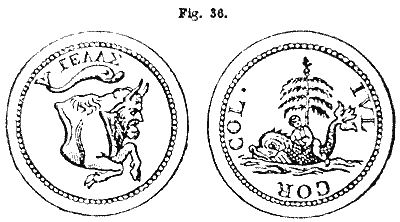
Now this very same method is used in the Romish Church for consecrating the water for baptism. The unsuspicious testimony of Bishop Hay leaves no doubt on this point: "It" [the water kept in the baptismal font], says he, "is blessed on the eve of Pentecost, because it is the Holy Ghost who gives to the waters of baptism the power and efficacy of sanctifying our souls, and because the baptism of Christ is 'with the Holy Ghost, and with fire' (Matt 3:11). In blessing the waters a LIGHTED TORCH is put into the font." Here, then, it is manifest that the baptismal regenerating water of Rome is consecrated just as the regenerating and purifying water of the Pagans was. Of what avail is it for Bishop Hay to say, with the view of sanctifying superstition and "making apostacy plausible," that this is done "to represent the fire of Divine love, which is communicated to the soul by baptism, and the light of good example, which all who are baptised ought to give." This is the fair face put on the matter; but the fact still remains that while the Romish doctrine in regard to baptism is purely Pagan, in the ceremonies connected with the Papal baptism one of the essential rites of the ancient fire-worship is still practised at this day, just as it was practised by the worshippers of Bacchus, the Babylonian Messiah. As Rome keeps up the remembrance of the fire-god passing through the waters and giving virtue to them, so when it speaks of the "Holy Ghost suffering for us in baptism," it in like manner commemorates the part which Paganism assigned to the Babylonian goddess when she plunged into the waters. The sorrows of Nimrod, or Bacchus, when in the waters were meritorious sorrows. The sorrows of his wife, in whom the Holy Ghost miraculously dwelt, were the same. The sorrows of the Madonna, then, when in these waters, fleeing from Typhon's rage, were the birth-throes by which children were born to God. And thus, even in the Far West, Chalchivitlycue, the Mexican "goddess of the waters," and "mother" of all the regenerate, was represented as purging the new-born infant from original sin, and "bringing it anew into the world." Now, the Holy Ghost was idolatrously worshipped in Babylon under the form of a "Dove." Under the same form, and with equal idolatry, the Holy Ghost is worshipped in Rome. When, therefore, we read, in opposition to every Scripture principle, that "the Holy Ghost suffered for us in baptism," surely it must now be manifest who is that Holy Ghost that is really intended. It is no other than Semiramis, the very incarnation of lust and all uncleanness.
Note
The Identity of the Scandinavian Odin and Adon of Babylon
1. Nimrod, or Adon, or Adonis, of Babylon, was the great war-god. Odin, as is well known, was the same. 2 Nimrod, in the character of Bacchus, was regarded as the god of wine; Odin is represented as taking no food but wine. For thus we read in the Edda: "As to himself he [Odin] stands in no need of food; wine is to him instead of every other aliment, according to what is said in these verses: The illustrious father of armies, with his own hand, fattens his two wolves; but the victorious Odin takes no other nourishment to himself than what arises from the unintermitted quaffing of wine" (MALLET, 20th Fable). 3. The name of one of Odin's sons indicates the meaning of Odin's own name. Balder, for whose death such lamentations were made, seems evidently just the Chaldee form of Baal-zer, "The seed of Baal"; for the Hebrew z, as is well known, frequently, in the later Chaldee, becomes d. Now, Baal and Adon both alike signify "Lord"; and, therefore, if Balder be admitted to be the seed or son of Baal, that is as much as to say that he is the son of Adon; and, consequently, Adon and Odin must be the same. This, of course, puts Odin a step back; makes his son to be the object of lamentation and not himself; but the same was the case also in Egypt; for there Horus the child was sometimes represented as torn in pieces, as Osiris had been. Clemens Alexandrinus says (Cohortatio), "they 03 lament an infant torn in pieces by the Titans." The lamentations for Balder are very plainly the counterpart of the lamentations for Adonis; and, of course, if Balder was, as the lamentations prove him to have been, the favourite form of the Scandinavian Messiah, he was Adon, or "Lord," as well as his father. 4. Then, lastly, the name of the other son of Odin, the mighty and warlike Thor, strengthens all the foregoing conclusions. Ninyas, the son of Ninus or Nimrod, on his father's death, when idolatry rose again, was, of course, from the nature of the mystic system, set up as Adon, "the Lord." Now, as Odin had a son called Thor, so the second Assyrian Adon had a son called Thouros. The name Thouros seems just to be another form of Zoro, or Doro, "the seed"; for Photius tells us that among the Greeks Thoros signified "Seed." The D is often pronounced as Th,--Adon, in the pointed Hebrew, being pronounced Athon.