The Two Babylons
Chapter II
Objects of Worship
Section II - Sub-Section III
The Child in Greece
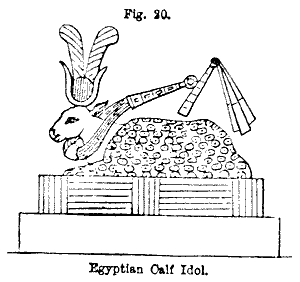
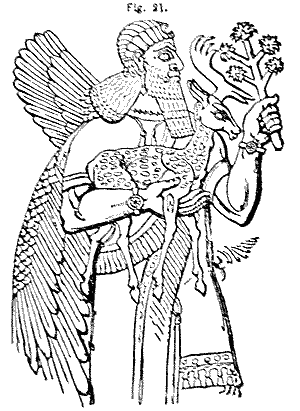
Thus much for Egypt. Coming into Greece, not only do we find evidence there to the same effect, but increase of that evidence. The god worshipped as a child in the arms of the great Mother in Greece, under the names of Dionysus, or Bacchus, or Iacchus, is, by ancient inquirers, expressly identified with the Egyptian Osiris. This is the case with Herodotus, who had prosecuted his inquiries in Egypt itself, who ever speaks of Osiris as Bacchus. To the same purpose is the testimony of Diodorus Siculus. "Orpheus," says he, "introduced from Egypt the greatest part of the mystical ceremonies, the orgies that celebrate the wanderings of Ceres, and the whole fable of the shades below. The rites of Osiris and Bacchus are the same; those of Isis and Ceres exactly resemble each other, except in name." Now, as if to identify Bacchus with Nimrod, "the Leopard-tamer," leopards were employed to draw his car; he himself was represented as clothed with a leopard's skin; his priests were attired in the same manner, or when a leopard's skin was dispensed with, the spotted skin of a fawn was used as a priestly robe in its stead. This very custom of wearing the spotted fawn-skin seems to have been imported into Greece originally from Assyria, where a spotted fawn was a sacred emblem, as we learn from the Nineveh sculptures; for there we find a divinity bearing a spotted fawn or spotted fallow-deer, in his arm, as a symbol of some mysterious import. The origin of the importance attached to the spotted fawn and its skin had evidently come thus: When Nimrod, as "the Leopard-tamer," began to be clothed in the leopard-skin, as the trophy of his skill, his spotted dress and appearance must have impressed the imaginations of those who saw him; and he came to be called not only the "Subduer of the Spotted one" (for such is the precise meaning of Nimr--the name of the leopard), but to be called "The spotted one" himself. We have distinct evidence to this effect borne by Damascius, who tells us that the Babylonians called "the only son" of the great goddess-mother "Momis, or Moumis." Now, Momis, or Moumis, in Chaldee, like Nimr, signified "The spotted one." Thus, then, it became easy to represent Nimrod by the symbol of the "spotted fawn," and especially in Greece, and wherever a pronunciation akin to that of Greece prevailed. The name of Nimrod, as known to the Greeks, was Nebrod. * The name of the fawn, as "the spotted one," in Greece was Nebros; ** and thus nothing could be more natural than that Nebros, the "spotted fawn," should become a synonym for Nebrod himself. When, therefore, the Bacchus of Greece was symbolised by the Nebros, or "spotted fawn," as we shall find he was symbolised, what could be the design but just covertly to identify him with Nimrod?
* In the Greek Septuagint, translated in Egypt, the name of Nimrod is "Nebrod."
** Nebros, the name of the fawn, signifies "the spotted one." Nmr, in Egypt, would also become Nbr; for Bunsen shows that m and b in that land were often convertible.
We have evidence that this god, whose emblem was the Nebros, was known as having the very lineage of Nimrod. From Anacreon, we find that a title of Bacchus was Aithiopais--i.e., "the son of Aethiops." But who was Aethiops? As the Aethiopians were Cushites, so Aethiops was Cush. "Chus," says Eusebius, "was he from whom came the Aethiopians." The testimony of Josephus is to the same effect. As the father of the Aethiopians, Cush was Aethiops, by way of eminence. Therefore Epiphanius, referring to the extraction of Nimrod, thus speaks: "Nimrod, the son of Cush, the Aethiop." Now, as Bacchus was the son of Aethiops, or Cush, so to the eye he was represented in that character. As Nin "the Son," he was portrayed as a youth or child; and that youth or child was generally depicted with a cup in his hand. That cup, to the multitude, exhibited him as the god of drunken revelry; and of such revelry in his orgies, no doubt there was abundance; but yet, after all, the cup was mainly a hieroglyphic, and that of the name of the god. The name of a cup, in the sacred language, was khus, and thus the cup in the hand of the youthful Bacchus, the son of Aethiops, showed that he was the young Chus, or the son of Chus. In a woodcut, the cup in the right hand of Bacchus is held up in so significant a way, as naturally to suggest that it must be a symbol; and as to the branch in the other hand, we have express testimony that it is a symbol. But it is worthy of notice that the branch has no leaves to determine what precise kind of a branch it is. It must, therefore, be a generic emblem for a branch, or a symbol of a branch in general; and, consequently, it needs the cup as its complement, to determine specifically what sort of a branch it is. The two symbols, then, must be read together, and read thus, they are just equivalent to--the "Branch of Chus"--i.e., "the scion or son of Cush." *
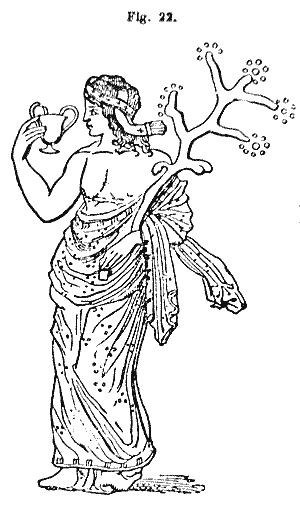
* Everyone knows that Homer's odzos Areos, or "Branch of Mars," is the same as a "Son of Mars." The hieroglyphic above was evidently formed on the same principle. That the cup alone in the hand of the youthful Bacchus was intended to designate him "as the young Chus," or "the boy Chus," we may fairly conclude from a statement of Pausanias, in which he represents "the boy Kuathos" as acting the part of a cup-bearer, and presenting a cup to Hercules (PAUSANIAS Corinthiaca) Kuathos is the Greek for a "cup," and is evidently derived from the Hebrew Khus, "a cup," which, in one of its Chaldee forms, becomes Khuth or Khuath. Now, it is well known that the name of Cush is often found in the form of Cuth, and that name, in certain dialects, would be Cuath. The "boy Kuathos," then, is just the Greek form of the "boy Cush," or "the young Cush."
There is another hieroglyphic connected with Bacchus that goes not a little to confirm this--that is, the Ivy branch. No emblem was more distinctive of the worship of Bacchus than this. Wherever the rites of Bacchus were performed, wherever his orgies were celebrated, the Ivy branch was sure to appear. Ivy, in some form or other, was essential to these celebrations. The votaries carried it in their hands, bound it around their heads, or had the Ivy leaf even indelibly stamped upon their persons. What could be the use, what could be the meaning of this? A few words will suffice to show it. In the first place, then, we have evidence that Kissos, the Greek name for Ivy, was one of the names of Bacchus; and further, that though the name of Cush, in its proper form, was known to the priests in the Mysteries, yet that the established way in which the name of his descendants, the Cushites, was ordinarily pronounced in Greece, was not after the Oriental fashion, but as "Kissaioi," or "Kissioi." Thus, Strabo, speaking of the inhabitants of Susa, who were the people of Chusistan, or the ancient land of Cush, says: "The Susians are called Kissioi," * --that is beyond all question, Cushites.
* STRABO. In Hesychius, the name is Kissaioi. The epithet applied to the land of Cush in Aeschylus is Kissinos. The above accounts for one of the unexplained titles of Apollo. "Kisseus Apollon" is plainly "The Cushite Apollo."
Now, if Kissioi be Cushites, then Kissos is Cush. Then, further, the branch of Ivy that occupied so conspicuous a place in all Bacchanalian celebrations was an express symbol of Bacchus himself; for Hesychius assures us that Bacchus, as represented by his priest, was known in the Mysteries as "The branch." From this, then, it appears how Kissos, the Greek name of Ivy, became the name of Bacchus. As the son of Cush, and as identified with him, he was sometimes called by his father's name--Kissos. His actual relation, however, to his father was specifically brought out by the Ivy branch, for "the branch of Kissos," which to the profane vulgar was only "the branch of Ivy," was to the initiated "The branch of Cush." *
* The chaplet, or head-band of Ivy, had evidently a similar hieroglyphical meaning to the above, for the Greek "Zeira Kissou" is either a "band or circlet of Ivy," or "The seed of Cush." The formation of the Greek "Zeira," a zone or enclosing band, from the Chaldee Zer, to encompass, shows that Zero "the seed," which was also pronounced Zeraa, would, in like manner, in some Greek dialects, become Zeira. Kissos, "Ivy," in Greek, retains the radical idea of the Chaldee Khesha or Khesa, "to cover or hide," from which there is reason to believe the name of Cush is derived, for Ivy is characteristically "The coverer or hider." In connection with this, it may be stated that the second person of the Phoenician trinity was Chursorus (WILKINSON), which evidently is Chus-zoro, "The seed of Cush." We have already seen that the Phoenicians derived their mythology from Assyria.
Now, this god, who was recognised as "the scion of Cush," was worshipped under a name, which, while appropriate to him in his vulgar character as the god of the vintage, did also describe him as the great Fortifier. That name was Bassareus, which, in its two-fold meaning, signified at once "The houser of grapes, or the vintage gatherer," and "The Encompasser with a wall," * in this latter sense identifying the Grecian god with the Egyptian Osiris, "the strong chief of the buildings," and with the Assyrian "Belus, who encompassed Babylon with a wall."
* Bassareus is evidently from the Chaldee Batzar, to which both Gesenius and Parkhurst give the two-fold meaning of "gathering in grapes," and "fortifying." Batzar is softened into Bazzar in the very same way as Nebuchadnetzar is pronounced Nebuchadnezzar. In the sense of "rendering a defence inaccessible," Gesenius adduces Jeremiah 51:53, "Though Babylon should mount up to heaven, and though she should fortify (tabatzar) the height of her strength, yet from me shall spoilers come unto her, saith the Lord." Here is evident reference to the two great elements in Babylon's strength, first her tower; secondly, her massive fortifications, or encompassing walls. In making the meaning of Batzar to be, "to render inaccessible," Gesenius seems to have missed the proper generic meaning of the term. Batzar is a compound verb, from Ba, "in," and Tzar, "to compass," exactly equivalent to our English word "en-compass."
Thus from Assyria, Egypt, and Greece, we have cumulative and overwhelming evidence, all conspiring to demonstrate that the child worshipped in the arms of the goddess-mother in all these countries in the very character of Ninus or Nin, "The Son," was Nimrod, the son of Cush. A feature here, or an incident there, may have been borrowed from some succeeding hero; but it seems impossible to doubt, that of that child Nimrod was the prototype, the grand original.
The amazing extent of the worship of this man indicates something very extraordinary in his character; and there is ample reason to believe, that in his own day he was an object of high popularity. Though by setting up as king, Nimrod invaded the patriarchal system, and abridged the liberties of mankind, yet he was held by many to have conferred benefits upon them, that amply indemnified them for the loss of their liberties, and covered him with glory and renown. By the time that he appeared, the wild beasts of the forest multiplying more rapidly than the human race, must have committed great depredations on the scattered and straggling populations of the earth, and must have inspired great terror into the minds of men. The danger arising to the lives of men from such a source as this, when population is scanty, is implied in the reason given by God Himself for not driving out the doomed Canaanites before Israel at once, though the measure of their iniquity was full (Exo 23:29,30): "I will not drive them out from before thee in one year, lest the land become desolate, and the beast of the field multiply against thee. By little and little I will drive them out from before thee, until thou be increased." The exploits of Nimrod, therefore, in hunting down the wild beasts of the field, and ridding the world of monsters, must have gained for him the character of a pre-eminent benefactor of his race. By this means, not less than by the bands he trained, was his power acquired, when he first began to be mighty upon the earth; and in the same way, no doubt, was that power consolidated. Then, over and above, as the first great city-builder after the flood, by gathering men together in masses, and surrounding them with walls, he did still more to enable them to pass their days in security, free from the alarms to which they had been exposed in their scattered life, when no one could tell but that at any moment he might be called to engage in deadly conflict with prowling wild beasts, in defence of his own life and of those who were dear to him. Within the battlements of a fortified city no such danger from savage animals was to be dreaded; and for the security afforded in this way, men no doubt looked upon themselves as greatly indebted to Nimrod. No wonder, therefore, that the name of the "mighty hunter," who was at the same time the prototype of "the god of fortifications," should have become a name of renown. Had Nimrod gained renown only thus, it had been well. But not content with delivering men from the fear of wild beasts, he set to work also to emancipate them from that fear of the Lord which is the beginning of wisdom, and in which alone true happiness can be found. For this very thing, he seems to have gained, as one of the titles by which men delighted to honour him, the title of the "Emancipator," or "Deliverer." The reader may remember a name that has already come under his notice. That name is the name of Phoroneus. The era of Phoroneus is exactly the era of Nimrod. He lived about the time when men had used one speech, when the confusion of tongues began, and when mankind was scattered abroad. He is said to have been the first that gathered mankind into communities, the first of mortals that reigned, and the first that offered idolatrous sacrifices. This character can agree with none but that of Nimrod. Now the name given to him in connection with his "gathering men together," and offering idolatrous sacrifice, is very significant. Phoroneus, in one of its meanings, and that one of the most natural, signifies the "Apostate." * That name had very likely been given him by the uninfected portion of the sons of Noah. But that name had also another meaning, that is, "to set free"; and therefore his own adherents adopted it, and glorified the great "Apostate" from the primeval faith, though he was the first that abridged the liberties of mankind, as the grand "Emancipator!" ** And hence, in one form or other, this title was handed down to this deified successors as a title of honour. ***
* From Pharo, also pronounced Pharang, or Pharong, "to cast off, to make naked, to apostatise, to set free." These meanings are not commonly given in this order, but as the sense of "casting off" explains all the other meanings, that warrants the conclusion that "to cast off" is the generic sense of the word. Now "apostacy" is very near akin to this sense, and therefore is one of the most natural.
** The Sabine goddess Feronia had evidently a relation to Phoroneus, as the "Emancipator." She was believed to be the "goddess of liberty," because at Terracina (or Anuxur) slaves were emancipated in her temple (Servius, in Aeneid), and because the freedmen of Rome are recorded on one occasion to have collected a sum of money for the purpose of offering it in her temple. (SMITH'S Classical Dictionary, "Feronia")
*** Thus we read of "Zeus Aphesio" (PAUSANIAS, Attica), that is "Jupiter Liberator" and of "Dionysus Eleuthereus" (PAUSANIAS), or "Bacchus the Deliverer." The name of Theseus seems to have had the same origin, from nthes "to loosen," and so to set free (the n being omissible). "The temple of Theseus" [at Athens] says POTTER "...was allowed the privilege of being a Sanctuary for slaves, and all those of mean condition that fled from the persecution of men in power, in memory that Theseus, while he lived, was an assister and protector of the distressed."
All tradition from the earliest times bears testimony to the apostacy of Nimrod, and to his success in leading men away from the patriarchal faith, and delivering their minds from that awe of God and fear of the judgments of heaven that must have rested on them while yet the memory of the flood was recent. And according to all the principles of depraved human nature, this too, no doubt, was one grand element in his fame; for men will readily rally around any one who can give the least appearance of plausibility to any doctrine which will teach that they can be assured of happiness and heaven at last, though their hearts and natures are unchanged, and though they live without God in the world.
How great was the boon conferred by Nimrod on the human race, in the estimation of ungodly men, by emancipating them from the impressions of true religion, and putting the authority of heaven to a distance from them, we find most vividly described in a Polynesian tradition, that carries its own evidence with it. John Williams, the well known missionary, tells us that, according to one of the ancient traditions of the islanders of the South Seas, "the heavens were originally so close to the earth that men could not walk, but were compelled to crawl" under them. "This was found a very serious evil; but at length an individual conceived the sublime idea of elevating the heavens to a more convenient height. For this purpose he put forth his utmost energy, and by the first effort raised them to the top of a tender plant called teve, about four feet high. There he deposited them until he was refreshed, when, by a second effort, he lifted them to the height of a tree called Kauariki, which is as large as the sycamore. By the third attempt he carried them to the summits of the mountains; and after a long interval of repose, and by a most prodigious effort, he elevated them to their present situation." For this, as a mighty benefactor of mankind, "this individual was deified; and up to the moment that Christianity was embraced, the deluded inhabitants worshipped him as the 'Elevator of the heavens.'" Now, what could more graphically describe the position of mankind soon after the flood, and the proceedings of Nimrod as Phoroneus, "The Emancipator," * than this Polynesian fable?
* The bearing of this name, Phoroneus, "The Emancipator," will be seen in Chapter III, Section I, "Christmas," where it is shown that slaves had a temporary emancipation at his birthday.
While the awful catastrophe by which God had showed His avenging justice on the sinners of the old world was yet fresh in the minds of men, and so long as Noah, and the upright among his descendants, sought with all earnestness to impress upon all under their control the lessons which that solemn event was so well fitted to teach, "heaven," that is, God, must have seemed very near to earth. To maintain the union between heaven and earth, and to keep it as close as possible, must have been the grand aim of all who loved God and the best interests of the human race. But this implied the restraining and discountenancing of all vice and all those "pleasures of sin," after which the natural mind, unrenewed and unsanctified, continually pants. This must have been secretly felt by every unholy mind as a state of insufferable bondage. "The carnal mind is enmity against God," is "not subject to His law," neither indeed is "able to be" so. It says to the Almighty, "Depart from us, for we desire not the knowledge of Thy ways." So long as the influence of the great father of the new world was in the ascendant, while his maxims were regarded, and a holy atmosphere surrounded the world, no wonder that those who were alienated from God and godliness, felt heaven and its influence and authority to be intolerably near, and that in such circumstances they "could not walk," but only "crawl,"--that is, that they had no freedom to "walk after the sight of their own eyes and the imaginations of their own hearts." From this bondage Nimrod emancipated them. By the apostacy he introduced, by the free life he developed among those who rallied around him, and by separating them from the holy influences that had previously less or more controlled them, he helped them to put God and the strict spirituality of His law at a distance, and thus he became the "Elevator of the heavens," making men feel and act as if heaven were afar off from earth, and as if either the God of heaven "could not see through the dark cloud," or did not regard with displeasure the breakers of His laws. Then all such would feel that they could breathe freely, and that now they could walk at liberty. For this, such men could not but regard Nimrod as a high benefactor.
Now, who could have imagined that a tradition from Tahiti would have illuminated the story of Atlas? But yet, when Atlas, bearing the heavens on his shoulders, is brought into juxtaposition with the deified hero of the South Seas, who blessed the world by heaving up the superincumbent heavens that pressed so heavily upon it, who does not see that the one story bears a relation to the other? *
* In the Polynesian story the heavens and earth are said to have been "bound together with cords," and the "severing" of these cords is said to have been effected by myriads of "dragon-flies," which, with their "wings," bore an important share in the great work. (WILLIAMS) Is there not here a reference to Nimrod's `63 "mighties" or "winged ones"? The deified "mighty ones" were often represented as winged serpents. See WILKINSON, vol. iv. p. 232, where the god Agathodaemon is represented as a "winged asp." Among a rude people the memory of such a representation might very naturally be kept up in connection with the "dragon-fly"; and as all the mighty or winged ones of Nimrod's age, the real golden age of paganism, when "dead, became daemons" (HESIOD, Works and Days), they would of course all alike be symbolised in the same way. If any be stumbled at the thought of such a connection between the mythology of Tahiti and of Babel, let it not be overlooked that the name of the Tahitian god of war was Oro (WILLIAMS), while "Horus (or Orus)," as Wilkinson calls the son of Osiris, in Egypt, which unquestionably borrowed its system from Babylon, appeared in that very character. (WILKINSON) Then what could the severing of the "cords" that bound heaven and earth together be, but just the breaking of the bands of the covenant by which God bound the earth to Himself, when on smelling a sweet savour in Noah's sacrifice, He renewed His covenant with him as head of the human race. This covenant did not merely respect the promise to the earth securing it against another universal deluge, but contained in its bosom a promise of all spiritual blessings to those who adhere to it. The smelling of the sweet savour in Noah's sacrifice had respect to his faith in Christ. When, therefore, in consequence of smelling that sweet savour, "God blessed Noah and his sons" (Gen 9:1), that had reference not merely to temporal but to spiritual and eternal blessings. Every one, therefore, of the sons of Noah, who had Noah's faith, and who walked as Noah walked, was divinely assured of an interest in "the everlasting covenant, ordered in all things and sure." Blessed were those bands by which God bound the believing children of men to Himself--by which heaven and earth were so closely joined together. Those, on the other hand, who joined in the apostacy of Nimrod broke the covenant, and in casting off the authority of God, did in effect say, "Let us break His bands asunder, and cast His cords from us." To this very act of severing the covenant connection between earth and heaven there is very distinct allusion, though veiled, in the Babylonian history of Berosus. There Belus, that is Nimrod, after having dispelled the primeval darkness, is said to have separated heaven and earth from one another, and to have orderly arranged the world. (BEROSUS, in BUNSEN) These words were intended to represent Belus as the "Formernew world that he forms; for there are creatures in existence before his Demiurgic power is exerted. The new world that Belus or Nimrod formed, was just the new order of things which he introduced when, setting at nought all Divine appointments, he rebelled against Heaven. The rebellion of the Giants is represented as peculiarly a rebellion against Heaven. To this ancient quarrel between the Babylonian potentates and Heaven, there is plainly an allusion in the words of Daniel to Nebuchadnezzar, when announcing that sovereign's humiliation and subsequent restoration, he says (Dan 4:26), "Thy kingdom shall be sure unto thee, when thou hast known that the HEAVENS do rule." of the world." But then it is a
Thus, then, it appears that Atlas, with the heavens resting on his broad shoulders, refers to no mere distinction in astronomical knowledge, however great, as some have supposed, but to a quite different thing, even to that great apostacy in which the Giants rebelled against Heaven, and in which apostacy Nimrod, "the mighty one," * as the acknowledged ringleader, occupied a pre-eminent place. **
* In the Greek Septuagint, translated in Egypt, the term "mighty" as applied in Genesis 10:8, to Nimrod, is rendered the ordinary name for a "Giant."
** IVAN and KALLERY, in their account of Japan, show that a similar story to that of Atlas was known there, for they say that once a day the Emperor "sits on his throne upholding the world and the empire." Now something like this came to be added to the story of Atlas, for PAUSANIAS shows that Atlas also was represented as upholding both earth and heaven.
According to the system which Nimrod was the grand instrument in introducing, men were led to believe that a real spiritual change of heart was unnecessary, and that so far as change was needful, they could be regenerated by mere external means. Looking at the subject in the light of the Bacchanalian orgies, which, as the reader has seen, commemorated the history of Nimrod, it is evident that he led mankind to seek their chief good in sensual enjoyment, and showed them how they might enjoy the pleasures of sin, without any fear of the wrath of a holy God. In his various expeditions he was always accompanied by troops of women; and by music and song, and games and revelries, and everything that could please the natural heart, he commended himself to the good graces of mankind.