The Two Babylons
Chapter I
Distinctive Character of the Two Systems
In leading proof of the Babylonian character of the Papal Church the first point to which I solicit the reader's attention, is the character of MYSTERY which attaches alike to the modern Roman and the ancient Babylonian systems. The gigantic system of moral corruption and idolatry described in this passage under the emblem of a woman with a "GOLDEN CUP IN HER HAND" (Rev 17:4), "making all nations DRUNK with the wine of her fornication" (Rev 17:2; 18:3), is divinely called "MYSTERY, Babylon the Great" (Rev 17:5). That Paul's "MYSTERY of iniquity," as described in 2 Thessalonians 2:7, has its counterpart in the Church of Rome, no man of candid mind, who has carefully examined the subject, can easily doubt. Such was the impression made by that account on the mind of the great Sir Matthew Hale, no mean judge of evidence, that he used to say, that if the apostolic description were inserted in the public "Hue and Cry" any constable in the realm would be warranted in seizing, wherever he found him, the bishop of Rome as the head of that "MYSTERY of iniquity." Now, as the system here described is equally characterized by the name of "MYSTERY," it may be presumed that both passages refer to the same system. But the language applied to the New Testament Babylon, as the reader cannot fail to see, naturally leads us back to the Babylon of the ancient world. As the Apocalyptic woman has in her hand A CUP, wherewith she intoxicates the nations, so was it with the Babylon of old. Of that Babylon, while in all its glory, the Lord thus spake, in denouncing its doom by the prophet Jeremiah: "Babylon hath been a GOLDEN CUP in the Lord's hand, that made all the earth drunken: the nations have drunken of her wine; therefore the nations are mad" (Jer 51:7). Why this exact similarity of language in regard to the two systems? The natural inference surely is, that the one stands to the other in the relation of type and antitype. Now, as the Babylon of the Apocalypse is characterized by the name of "MYSTERY," so the grand distinguishing feature of the ancient Babylonian system was the Chaldean "MYSTERIES," that formed so essential a part of that system. And to these mysteries, the very language of the Hebrew prophet, symbolical though of course it is, distinctly alludes, when he speaks of Babylon as a "golden CUP." To drink of "mysterious beverages," says Salverte, was indispensable on the part of all who sought initiation in these Mysteries. These "mysterious beverages" were composed of "wine, honey, water, and flour." From the ingredients avowedly used, and from the nature of others not avowed, but certainly used, there can be no doubt that they were of an intoxicating nature; and till the aspirants had come under their power, till their understandings had been dimmed, and their passions excited by the medicated draught, they were not duly prepared for what they were either to hear or to see. If it be inquired what was the object and design of these ancient "Mysteries," it will be found that there was a wonderful analogy between them and that "Mystery of iniquity" which is embodied in the Church of Rome. Their primary object was to introduce privately, by little and little, under the seal of secrecy and the sanction of an oath, what it would not have been safe all at once and openly to propound. The time at which they were instituted proved that this must have been the case. The Chaldean Mysteries can be traced up to the days of Semiramis, who lived only a few centuries after the flood, and who is known to have impressed upon them the image of her own depraved and polluted mind. *
* AMMIANUS MARCELLINUS compared with JUSTINUS, Historia and EUSEBIUS' Chronicle. Eusebius says that Ninus and Semiramis reigned in the time of Abraham.
That beautiful but abandoned queen of Babylon was not only herself a paragon of unbridled lust and licentiousness, but in the Mysteries which she had a chief hand in forming, she was worshipped as Rhea, the great "MOTHER" of the gods, with such atrocious rites as identified her with Venus, the MOTHER of all impurity, and raised the very city where she had reigned to a bad eminence among the nations, as the grand seat at once of idolatry and consecrated prostitution. *
* A correspondent has pointed out a reference by Pliny to the cup of Semiramis, which fell into the hands of the victorious Cyrus. Its gigantic proportions must have made it famous among the Babylonians and the nations with whom they had intercourse. It weighed fifteen talents, or 1200 pounds. PLINII, Hist. Nat.
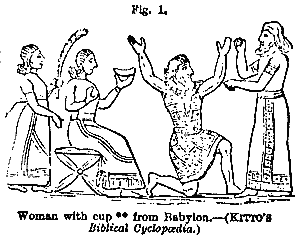
Thus was this Chaldean queen a
fit and remarkable prototype of the "Woman" in the
Apocalypse, with the golden cup in her hand, and the name on her
forehead, "Mystery, Babylon the Great, the MOTHER of harlots and
abominations of the earth." The Apocalyptic emblem of the Harlot woman
with the cup in her hand was even embodied in the symbols of idolatry,
derived from ancient Babylon, as they were exhibited in Greece; for
thus was the Greek Venus originally represented, (see
note below) and it is singular that in our own day, and so
far as appears for the first time, the Roman Church has actually taken
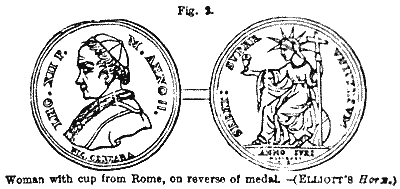
this very symbol as her own chosen emblem. In 1825, on occasion of the
jubilee, Pope Leo XII struck a medal, bearing on the one side his own
image, and on the other, that of the Church of Rome symbolised as a
"Woman," holding in her left hand a cross, and in her right a CUP, with
the legend around her, "Sedet super universum," "The
whole world is her seat." Now the period when Semiramis lived,--a
period when the patriarchal faith was still fresh in the minds of men,
when Shem was still alive, * to rouse the minds of the faithful to
rally around the banner for the truth and cause of God, made it
hazardous all at once and publicly to set up such a system as was
inaugurated by the Babylonian queen.
* For the age of Shem see Genesis 11:10, 11. According to this, Shem lived 502 years after the flood, that is, according to the Hebrew chronology, till BC 1846. The age of Ninus, the husband of Semiramis, as stated in a former note, according to Eusebius, synchronised with that of Abraham, who was born BC 1996. It was only about nine years, however, before the end of the reign of Ninus, that the birth of Abraham is said to have taken place. (SYNCELLUS) Consequently, on this view, the reign of Ninus must have terminated, according to the usual chronology, about BC 1987. Clinton, who is of high authority in chronology, places the reign of Ninus somewhat earlier. In his Fasti Hellenici he makes his age to have been BC 2182. Layard (in his Nineveh and its Remains) subscribes to this opinion. Semiramis is said to have survived her husband forty-two years. (SYNCELL) Whatever view, therefore, be adopted in regard to the age of Ninus, whether that of Eusebius, or that at which Clinton and Layard have arrived, it is evident that Shem long survived both Ninus and his wife. Of course, this argument proceeds on the supposition of the correctness of the Hebrew chronology. For conclusive evidence on that subject, see note 2 below.
We know, from the statements
in Job, that among patriarchal tribes that had nothing whatever to do
with Mosaic institutions, but which adhered to the pure faith of the
patriarchs, idolatry in any shape was held to be a crime, to be visited
with signal and summary punishment on the heads of those who practised
it. "If I beheld the sun," said Job, "when it shined, or the moon
walking in brightness; and my heart hath been secretly enticed, and *
my mouth hath kissed my hand; this also were an iniquity to
be punished by the judge; for I should have denied the God
that is above" (Job 31:26-28).
* That which I have rendered "and" is in the authorized version "or," but there is no reason for such a rendering, for the word in the original is the very same as that which connects the previous clause, "and my heart," &c.
Now if this was the case in Job's day, much more must it have been the case at the earlier period when the Mysteries were instituted. It was a matter, therefore, of necessity, if idolatry were to be brought in, and especially such foul idolatry as the Babylonian system contained in its bosom, that it should be done stealthily and in secret. *
* It will be seen by-and-by what cogent reason there was, in point of fact, for the profoundest secrecy in the matter. See Chapter II
Even though introduced by the hand of power, it might have produced a revulsion, and violent attempts might have been made by the uncorrupted portion of mankind to put it down; and at all events, if it had appeared at once in all its hideousness, it would have alarmed the consciences of men, and defeated the very object in view. That object was to bind all mankind in blind and absolute submission to a hierarchy entirely dependent on the sovereigns of Babylon. In the carrying out of this scheme, all knowledge, sacred and profane, came to be monopolized by the priesthood, who dealt it out to those who were initiated in the "Mysteries" exactly as they saw fit, according as the interests of the grand system of spiritual despotism they had to administer might seem to require. Thus the people, wherever the Babylonian system spread, were bound neck and heel to the priests. The priests were the only depositaries of religious knowledge; they only had the true tradition by which the writs and symbols of the public religion could be interpreted; and without blind and implicit submission to them, what was necessary for salvation could not be known. Now compare this with the early history of the Papacy, and with its spirit and modus operandi throughout, and how exact was the coincidence! Was it in a period of patriarchal light that the corrupt system of the Babylonian "Mysteries" began? It was in a period of still greater light that that unholy and unscriptural system commenced, that has found such rank development in the Church of Rome. It began in the very age of the apostles, when the primitive Church was in its flower, when the glorious fruits of Pentecost were everywhere to be seen, when martyrs were sealing their testimony for the truth with their blood. Even then, when the Gospel shone so brightly, the Spirit of God bore this clear and distinct testimony by Paul: "THE MYSTERY OF INIQUITY DOTH ALREADY WORK" (2 Thessalonians 2:7). That system of iniquity which then began it was divinely foretold was to issue in a portentous apostasy, that in due time would be awfully "revealed," and would continue until it should be destroyed "by the breath of the Lord's mouth, and consumed by the brightness of His coming." But at its first introduction into the Church, it came in secretly and by stealth, with "all DECEIVABLENESS of unrighteousness." It wrought "mysteriously" under fair but false pretences, leading men away from the simplicity of the truth as it is in Jesus. And it did so secretly, for the very same reason that idolatry was secretly introduced in the ancient Mysteries of Babylon; it was not safe, it was not prudent to do otherwise. The zeal of the true Church, though destitute of civil power, would have aroused itself, to put the false system and all its abettors beyond the pale of Christianity, if it had appeared openly and all at once in all its grossness; and this would have arrested its progress. Therefore it was brought in secretly, and by little and little, one corruption being introduced after another, as apostasy proceeded, and the backsliding Church became prepared to tolerate it, till it has reached the gigantic height we now see, when in almost every particular the system of the Papacy is the very antipodes of the system of the primitive Church. Of the gradual introduction of all that is now most characteristic of Rome, through the working of the "Mystery of iniquity," we have very striking evidence, preserved even by Rome itself, in the inscriptions copied from the Roman catacombs. These catacombs are extensive excavations underground in the neighborhood of Rome, in which the Christians, in times of persecution during the first three centuries, celebrated their worship, and also buried their dead. On some of the tombstones there are inscriptions still to be found, which are directly in the teeth of the now well-known principles and practices of Rome. Take only one example: What, for instance, at this day is a more distinguishing mark of the Papacy than the enforced celibacy of the clergy? Yet from these inscriptions we have most decisive evidence, that even in Rome, there was a time when no such system of clerical celibacy was known. Witness the following, found on different tombs:
1. "To Basilius, the presbyter, and Felicitas, his wife. They made this for themselves."
2. "Petronia, a priest's wife, the type of modesty. In this place I lay my bones. Spare your tears, dear husband and daughter, and believe that it is forbidden to weep for one who lives in God." (DR. MAITLAND'S Church in the Catacombs) A prayer here and there for the dead: "May God refresh thy spirit," proves that even then the Mystery of iniquity had begun to work; but inscriptions such as the above equally show that it had been slowly and cautiously working,--that up to the period to which they refer, the Roman Church had not proceeded the length it has done now, of absolutely "forbidding its priests to 'marry.'" Craftily and gradually did Rome lay the foundation of its system of priestcraft, on which it was afterwards to rear so vast a superstructure. At its commencement, "Mystery" was stamped upon its system.
But this feature of "Mystery" has adhered to it throughout its whole course. When it had once succeeded in dimming the light of the Gospel, obscuring the fullness and freeness of the grace of God, and drawing away the souls of men from direct and immediate dealings with the One Grand Prophet and High Priest of our profession, a mysterious power was attributed to the clergy, which gave them "dominion over the faith" of the people--a dominion directly disclaimed by apostolic men (2 Corinthians 1:24), but which, in connection with the confessional, has become at least as absolute and complete as was ever possessed by Babylonian priest over those initiated in the ancient Mysteries. The clerical power of the Roman priesthood culminated in the erection of the confessional. That confessional was itself borrowed from Babylon. The confession required of the votaries of Rome is entirely different from the confession prescribed in the Word of God. The dictate of Scripture in regard to confession is, "Confess your faults one to another" (James 5:16), which implies that the priest should confess to the people, as well as the people to the priest, if either should sin against the other. This could never have served any purpose of spiritual despotism; and therefore, Rome, leaving the Word of God, has had recourse to the Babylonian system. In that system, secret confession to the priest, according to a prescribed form, was required of all who were admitted to the "Mysteries"; and till such confession had been made, no complete initiation could take place. Thus does Salverte refer to this confession as observed in Greece, in rites that can be clearly traced to a Babylonian origin: "All the Greeks, from Delphi to Thermopylae, were initiated in the Mysteries of the temple of Delphi. Their silence in regard to everything they were commanded to keep secret was secured both by the fear of the penalties threatened to a perjured revelation, and by the general CONFESSION exacted of the aspirants after initiation--a confession which caused them greater dread of the indiscretion of the priest, than gave him reason to dread their indiscretion." This confession is also referred to by Potter, in his "Greek Antiquities," though it has been generally overlooked. In his account of the Eleusinian mysteries, after describing the preliminary ceremonies and instructions before the admission of the candidates for initiation into the immediate presence of the divinities, he thus proceeds: "Then the priest that initiated them called the Hierophant, proposed certain QUESTIONs, as, whether they were fasting, &c., to which they returned answers in a set form." The etcetera here might not strike a casual reader; but it is a pregnant etcetera, and contains a great deal. It means, Are you free from every violation of chastity? and that not merely in the sense of moral impurity, but in that factitious sense of chastity which Paganism always cherishes. Are you free from the guilt of murder?--for no one guilty of slaughter, even accidentally, could be admitted till he was purged from blood, and there were certain priests, called Koes, who "heard confessions" in such cases, and purged the guilt away. The strictness of the inquiries in the Pagan confessional is evidently implied in certain licentious poems of Propertius, Tibullus, and Juvenal. Wilkinson, in his chapter on "Private Fasts and Penance," which, he says, "were strictly enforced," in connection with "certain regulations at fixed periods," has several classical quotations, which clearly prove whence Popery derived the kind of questions which have stamped that character of obscenity on its confessional, as exhibited in the notorious pages of Peter Dens. The pretence under which this auricular confession was required, was, that the solemnities to which the initiated were to be admitted were so high, so heavenly, so holy, that no man with guilt lying on his conscience, and sin unpurged, could lawfully be admitted to them. For the safety, therefore of those who were to be initiated, it was held to be indispensable that the officiating priest should thoroughly probe their consciences, lest coming without due purgation from previous guilt contracted, the wrath of the gods should be provoked against the profane intruders. This was the pretence; but when we know the essentially unholy nature, both of the gods and their worship, who can fail to see that this was nothing more than a pretence; that the grand object in requiring the candidates for initiation to make confession to the priest of all their secret faults and shortcomings and sins, was just to put them entirely in the power of those to whom the inmost feelings of their souls and their most important secrets were confided? Now, exactly in the same way, and for the very same purposes, has Rome erected the confessional. Instead of requiring priests and people alike, as the Scripture does, to "confess their faults one to another," when either have offended the other, it commands all, on pain of perdition, to confess to the priest, * whether they have transgressed against him or no, while the priest is under no obligation to confess to the people at all.
* BISHOP HAY'S Sincere Christian. In this work, the following question and answer occur: "Q. Is this confession of our sins necessary for obtaining absolution? A. It is ordained by Jesus Christ as absolutely necessary for this purpose." See also Poor Man's Manual, a work in use in Ireland.
Without such confession, in the Church of Rome, there can be no admission to the Sacraments, any more than in the days of Paganism there could be admission without confession to the benefit of the Mysteries. Now, this confession is made by every individual, in SECRECY AND IN SOLITUDE, to the priest sitting in the name and clothed with the authority of God, invested with the power to examine the conscience, to judge the life, to absolve or condemn according to his mere arbitrary will and pleasure. This is the grand pivot on which the whole "Mystery of iniquity," as embodied in the Papacy, is made to turn; and wherever it is submitted to, admirably does it serve the design of binding men in abject subjection to the priesthood.
In conformity with the principle out of which the confessional grew, the Church, that is, the clergy, claimed to be the sole depositaries of the true faith of Christianity. As the Chaldean priests were believed alone to possess the key to the understanding of the Mythology of Babylon, a key handed down to them from primeval antiquity, so the priests of Rome set up to be the sole interpreters of Scripture; they only had the true tradition, transmitted from age to age, without which it was impossible to arrive at its true meaning. They, therefore, require implicit faith in their dogmas; all men were bound to believe as the Church believed, while the Church in this way could shape its faith as it pleased. As possessing supreme authority, also, over the faith, they could let out little or much, as they judged most expedient; and "RESERVE" in teaching the great truths of religion was as essential a principle in the system of Babylon, as it is in Romanism or Tractariansim at this day. * It was this priestly claim to dominion over the faith of men, that "imprisoned the truth in unrighteousness" ** in the ancient world, so that "darkness covered the earth, and gross darkness the people." It was the very same claim, in the hands of the Roman priests, that ushered in the dark ages, when, through many a dreary century, the Gospel was unknown, and the Bible a sealed book to millions who bore the name of Christ. In every respect, then, we see how justly Rome bears on its forehead the name, "Mystery, Babylon the Great."
* Even among the initiated there was a difference. Some were admitted only to the "Lesser Mysteries"; the "Greater" were for a favoured few. WILKINSON'S Ancient Egyptians
** Romans 1:18. The best interpreters render the passage as given above. It will be observed Paul is expressly speaking of the heathen.
Woman with
Golden
Cup
In Pausanias we find an
account of a goddess represented in the very attitude of the
Apocalyptic "Woman." "But of this stone [Parian marble] Phidias," says
he, "made a statue of Nemesis; and on the head of the goddess there is
a crown adorned with stags, and images of victory of no great
magnitude. In her left hand, too, she holds a branch of an ash tree,
and in her right A CUP, in which Ethiopians are carved." (PAUSANIAS,
Attica) Pausanias declares himself unable to
assign any reason why "the
Ethiopians" were carved on the cup; but the
meaning of the Ethiopians and the stags too will be apparent to all who
read further. We find, however, from statements made in the same
chapter, that though Nemesis is commonly represented as the goddess of
revenge, she must have been also known in quite a different character.
Thus Pausanias proceeds, commenting on the statue: "But neither has
this statue of the goddess wings. Among the Smyrneans, however, who
possess the most holy images of Nemesis, I perceived afterwards that
these statues had wings. For, as this goddess principally
pertains to lovers, on this account they may be supposed to
have given wings to Nemesis, as well as to love," i.e., Cupid. The
giving of wings to Nemesis, the goddess who "principally pertained to
lovers," because Cupid, the god of love, bore them,
implies that, in the opinion of Pausanias, she was the counterpart
of Cupid, or the goddess of love--that is, Venus.
While this is the inference naturally to be deduced from the words of
Pausanias, we find it confirmed by an express statement of Photius,
speaking of the statue of Rhamnusian Nemesis: "She was at first erected
in the form of Venus, and therefore bore also the branch of an apple
tree." (PHOTII, Lexicon) Though a goddess of love
and a goddess of revenge might seem very remote in their characters
from one another, yet it is not difficult to see how this must have
come about. The goddess who was revealed to the initiated in the
Mysteries, in the most alluring manner, was also known to be most
unmerciful and unrelenting in taking vengeance upon those who revealed
these Mysteries; for every such one who was discovered was unsparingly
put to death. (POTTER'S Antiquities, "Eleusinia")
Thus, then, the cup-bearing goddess was at once Venus, the goddess of
licentiousness, and Nemesis, the stern and unmerciful one to all who
rebelled against her authority. How remarkable a type of the woman,
whom John saw, described in one aspect as the "Mother of harlots," and
in another as "Drunken with the blood of the saints"!
Hebrew
Chronology
Dr. Hales has attempted to substitute the longer chronology of the Septuagint for the Hebrew chronology. But this implies that the Hebrew Church, as a body, was not faithful to the trust committed to it in respect to the keeping of the Scriptures, which seems distinctly opposed to the testimony of our Lord in reference to these Scriptures (John 5:39; 10:35), and also to that of Paul (Rom 3:2), where there is not the least hint of unfaithfulness. Then we can find a reason that might induce the translators of the Septuagint in Alexandria to 83 lengthen out the period of the ancient history of the world; we can find no reason to induce the Jews in Palestine to shorten it. The Egyptians had long, fabulous eras in their history, and Jews dwelling in Egypt might wish to make their sacred history go as far back as they could, and the addition of just one hundred years in each case, as in the Septuagint, to the ages of the patriarchs, looks wonderfully like an intentional forgery; whereas we cannot imagine why the Palestine Jews should make any change in regard to this matter at all. It is well known that the Septuagint contains innumerable gross errors and interpolations.
Bunsen casts overboard all Scriptural chronology whatever, whether Hebrew, Samaritan, or Greek, and sets up the unsupported dynasties of Manetho, as if they were sufficient to over-ride the Divine word as to a question of historical fact. But, if the Scriptures are not historically true, we can have no assurance of their truth at all. Now it is worthy of notice that, though Herodotus vouches for the fact that at one time there were no fewer than twelve contemporaneous kings in Egypt, Manetho, as observed by Wilkinson, has made no allusion to this, but has made his Thinite, Memphite, and Diospolitan dynasties of kings, and a long etcetera of other dynasties, all successive!
The period over which the dynasties of Manetho extend, beginning with Menes, the first king of these dynasties, is in itself a very lengthened period, and surpassing all rational belief. But Bunsen, not content with this, expresses his very confident persuasion that there had been long lines of powerful monarchs in Upper and Lower Egypt, "during a period of from two to four thousand years," even before the reign of Menes. In coming to such a conclusion, he plainly goes upon the supposition that the name Mizraim, which is the Scriptural name of the land of Egypt, and is evidently derived from the name of the son of Ham, and grandson of Noah, is not, after all, the name of a person, but the name of the united kingdom formed under Menes out of "the two Misr," "Upper and Lower Egypt," which had previously existed as separate kingdoms, the name Misrim, according to him, being a plural word. This derivation of the name Mizraim, or Misrim, as a plural word, infallibly leaves the impression that Mizraim, the son of Ham, must be only a mythical personage. But there is no real reason for thinking that Mizraim is a plural word, or that it became the name of "the land of Ham," from any other reason than because that land was also the land of Ham's son. Mizraim, as it stands in the Hebrew of Genesis, without the points, is Metzrim; and Metzr-im signifies "The encloser or embanker of the sea" (the word being derived from Im, the same as Yam, "the sea," and Tzr, "to enclose," with the formative M prefixed).
If the accounts which ancient history has handed down to us of the original state of Egypt be correct, the first man who formed a settlement there must have done the very thing implied in this name. Diodorus Siculus tells us that, in primitive times, that which, when he wrote, "was Egypt, was said to have been not a country, but one universal sea." Plutarch also says (De Iside) that Egypt was sea. From Herodotus, too, we have very striking evidence to the same effect. He excepts the province of Thebes from his statement; but when it is seen that "the province of Thebes" did not belong to Mizraim, or Egypt proper, which, says the author of the article "Mizraim" in Biblical Cyclopoedia, "properly denotes Lower Egypt"; the testimony of Herodotus will be seen entirely to agree with that of Diodorus and Plutarch. His statement is, that in the reign of the first king, "the whole of Egypt (except the province of Thebes) was an extended marsh. No part of that which is now situate beyond the lake Moeris was to be seen, the distance between which lake and the sea is a journey of seven days." Thus all Mizraim or Lower Egypt was under water.
This state of the country arose from the unrestrained overflowing of the Nile, which, to adopt the language of Wilkinson, "formerly washed the foot of the sandy mountains of the Lybian chain." Now, before Egypt could be fit for being a suitable place for human abode--before it could become what it afterwards did become, one of the most fertile of all lands, it was indispensable that bounds should be set to the overflowings of the sea (for by the very name of the Ocean, or Sea, the Nile was anciently called--DIODORUS), and that for this purpose great embankments should enclose or confine its waters. If Ham's son, then, led a colony into Lower Egypt and settled it there, this very work he must have done. And what more natural than that a name should be given him in memory of his great achievement? and what name so exactly descriptive as Metzr-im, "The embanker of the sea," or as the name is found at this day applied to all Egypt (WILKINSON), Musr or Misr? Names always tend to abbreviation in the mouths of a people, and, therefore, "The land of Misr" is evidently just "The land of the embanker." From this statement it follows that the "embanking of the sea"--the "enclosing" of it within certain bounds, was the making of it as a river, so far as Lower Egypt was concerned. Viewing the matter in this light, what a meaning is there in the Divine language in Ezekiel 29:3, where judgments are denounced against the king of Egypt, the representative of Metzr-im, "The embanker of the sea," for his pride: "Behold, I am against thee, Pharaoh, king of Egypt, the great dragon that lieth in the midst of his rivers, which saith, My river is mine own, I have made it for myself."
When we turn to what is recorded of the doings of Menes, who, by Herodotus, Manetho, and Diodorus alike, is made the first historical king of Egypt, and compare what is said of him, with this simple explanation of the meaning of the name of Mizraim, how does the one cast light on the other? Thus does Wilkinson describe the great work which entailed fame on Menes, "who," says he, "is allowed by universal consent to have been the first sovereign of the country." "Having diverted the course of the Nile, which formerly washed the foot of the sandy mountains of the Lybian chain, he obliged it to run in the centre of the valley, nearly at an equal distance between the two parallel ridges of mountains which border it on the east and west; and built the city of Memphis in the bed of the ancient channel. This change was effected by constructing a dyke about a hundred stadia above the site of the projected city, whose lofty mounds and strong EMBANKMENTS turned the water to the eastward, and effectually CONFINED the river to its new bed. The dyke was carefully kept in repair by succeeding kings; and, even as late as the Persian invasion, a guard was always maintained there, to overlook the necessary repairs, and to watch over the state of the embankments." (Egyptians)
When we see that Menes, the first of the acknowledged historical kings of Egypt, accomplished that very achievement which is implied in the name of Mizraim, who can resist the conclusion that menes and Mizraim are only two different names for the same person? And if so, what becomes of Bunsen's vision of powerful dynasties of sovereigns "during a period of from two to four thousand years" before the reign of Menes, by which all Scriptural chronology respecting Noah and his sons was to be upset, when it turns out that Menes must have been Mizraim, the grandson of Noah himself? Thus does Scripture contain, within its own bosom, the means of vindicating itself; and thus do its minutest statements, even in regard to matters of fact, when thoroughly understood, shed surprising light on the dark parts of the history of the world.